10 Reasons to Love Living in the New River Valley This Spring
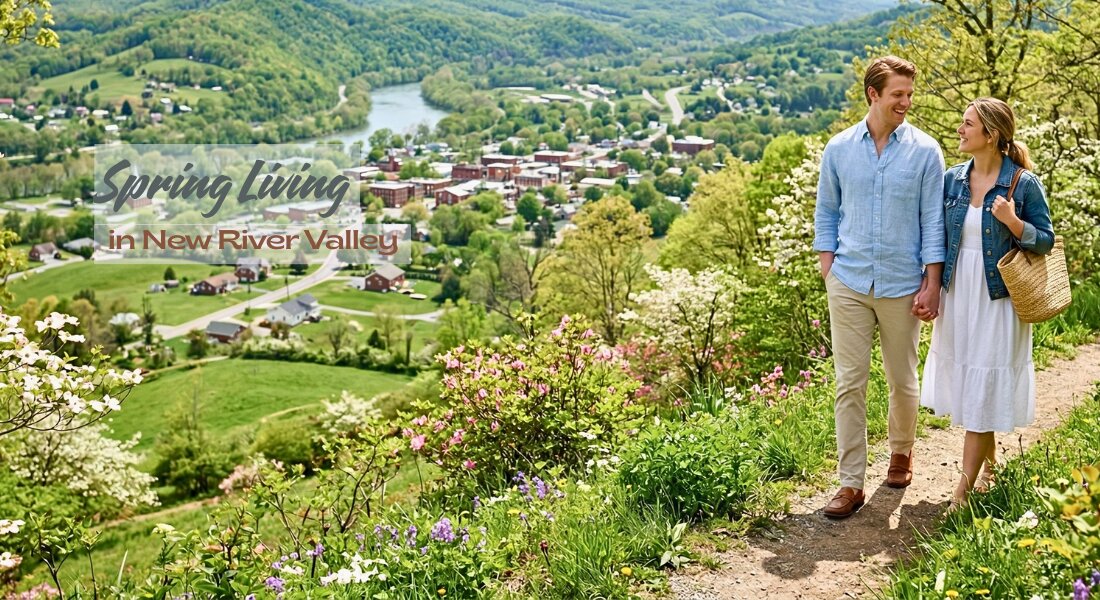
Spring in the New River Valley means waking up to blooming Blue Ridge hillsides and a community calendar packed with events. It’s an incredible time to live in the NRV.
The real estate market still offers genuine value compared to Virginia’s larger metros. If you’re thinking about a move to the New River Valley, there’s honestly no better time to see it.
The NRV spans five communities: the City of Radford, Montgomery County, Pulaski County, Giles County, and Floyd County. Each one has its own character, and together they make up one of Virginia’s most livable regions.
This post will cover 10 reasons to love living in the NRV this spring.
New River Valley Real Estate Market Watch
As of February 2026, the median sale price of homes in Radford was $249,000. However, NRV real estate trends are always changing. Contact the Louise Baker Team for help buying or selling a home in Virginia’s New River Valley.
1. The Outdoor Scene Comes Alive
One of the first things I point out to buyers is how much is right outside the door here. Giles County’s Mill Creek Falls draws hikers as soon as the rains pick up in spring. Wildwood Park in Radford fills with wildflowers and more than 70 species of butterflies. The Pete Dye River Course in Pulaski County is one of the most scenic places to play golf in the state.
And it’s not just lifestyle. According to NAR’s Community and Transportation Preferences Survey, proximity to parks and green space consistently ranks among the features buyers prioritize when choosing where to live. The NRV has that in abundance.
2. Virginia Tech Keeps the Economy Stable
I’ve been working this market long enough to appreciate what Virginia Tech means for the region. According to Virginia Tech’s 2026 Economic and Community Impact Report, the Blacksburg campus generated $3.4 billion in economic impact during fiscal year 2025. University activity returned roughly $10 to Virginia’s economy for every $1 the state invested.
That kind of anchor institution keeps employment stable and housing demand consistent. If you’re a buyer thinking about long-term value, that matters a great deal.
3. There’s Always Something Going On
I’ve lived and worked here long enough to know this is not a boring place to be in the spring. Blacksburg Fork and Cork brings together local restaurants, wineries, and breweries for a wonderful outdoor afternoon. Virginia Tech hosts its International Street Fair, which draws thousands of people to campus each year. Radford University baseball and softball give weekday evenings a relaxed, small-town feel.
When I talk to people relocating from larger cities, this is often what surprises them most. There’s a real sense of community here, and you feel it quickly.
4. Local Businesses Are Investing Here Too
Community investment is a strong signal of a healthy real estate market. In late February 2026, Pulaski welcomed the Great Wilderness Brewing Company, the town’s first brewery. It opened inside a building more than 120 years old after seven years of planning. The project brought 10 new jobs and $1 million in capital investment to Pulaski’s historic district.
When entrepreneurs make that kind of long-term commitment to a place, it tells you something. In my experience, that street-level energy tends to show up in property values not long after.
5. Five Communities, Each With Its Own Character
One of the NRV’s most underappreciated advantages is variety. Blacksburg has walkable streets, craft coffee shops, and a tech-forward job market. Floyd County moves at a slower, more artistic pace with a world-famous music scene and farm-to-table culture. Pulaski is seeing real momentum downtown. Giles County draws outdoor lovers to Mountain Lake and the Appalachian Trail. Radford offers affordability and a genuine small-city feel with river access and its own university.
We’d love to take you through each one. Come explore the communities and see which one feels like home.
6. You Get More Home for Your Money Here
Compared to the Northern Virginia suburbs or Richmond, the New River Valley offers significantly more home for the dollar. Median prices in Montgomery County and surrounding areas remain well below the Virginia state average. People can find larger homes, land, mountain views, and river access. These are realistic opportunities at price points that simply don’t exist elsewhere in the state.
Spring also tends to bring more inventory, which gives buyers more room to compare and negotiate than they’d have in the winter months.
7. Cutting-Edge Research Happening in Your Backyard
The research environment is one I genuinely enjoy sharing with buyers. Virginia Tech’s Kentland Experimental Aerial Systems (KEAS) Lab is testing autonomous drones designed to gather hyperlocal atmospheric data. The goal is to dramatically improve weather forecasting for agriculture, energy, transportation, and construction. It’s the kind of research that attracts talent and investment to a region over time.
That’s good for the community and, in my experience, good for property values too.
8. A Genuine Small-Town Quality of Life
Three world-class universities operate within the NRV. They provide access to performing arts, sporting events, lectures, and cultural programming that most small communities lack. At the same time, traffic is manageable, the cost of living is low relative to Virginia’s urban centers, and neighbors still tend to know each other.
For families, retirees, and remote workers, that’s a hard thing to find elsewhere.
9. Spring Gives You the Best Selection
The spring market brings more listings, more open houses, and more opportunities to compare properties before making a decision. Buyers who start their search in April and May often close before summer. That means they are settled and enjoying the region by the time fall arrives.
If you’re ready to start, we’re here to help you navigate it. We know each community well and can help you find the right fit and determine what fair pricing looks like right now.
10. The People Make It Worth Staying
Every region claims community spirit. The New River Valley earns it. People come for a job, a school, or a partner, and then they just stay. Some families have farmed the same land in Floyd County for generations. Some Virginia Tech alumni left for years, came back, and never left again. There’s something about this place that holds people.
That’s the kind of community where buying makes sense, and where putting down roots tends to feel right.
Thinking About a Move? Here’s What People Ask First
Is the New River Valley a good place to live year-round?
Absolutely, and I say that as someone who has been here through all four seasons. The NRV has a low cost of living, abundant outdoor recreation, and stable employment anchored by Virginia Tech and Radford University. People who move here tend to stay, and that tells you a lot.
What are home prices like in the New River Valley?
Generally well below the Virginia state average, which is one of the things that draws buyers here. You can find space, land, and proximity to nature at price points that are hard to match elsewhere in the state. Blacksburg tends to command a premium because of demand for Virginia Tech, but even there, the value holds up well compared to other university towns.
Which NRV community is best for families?
Montgomery County and Blacksburg are where we see many families settle, largely because of the schools and the resources that come with Virginia Tech. Radford and Pulaski County are worth a serious look, too, especially if affordability is a priority.
When is the best time to buy a home in the New River Valley?
Spring, without question. More inventory, more options, more time to make a thoughtful decision. Buyers who start in March or April usually close before summer and spend the rest of the year enjoying where they landed.
Ready to See It for Yourself?
I’ve spent decades getting to know every corner of this region, and I still find things to love about it. If you’re curious about what a move to the NRV could actually look like for you, let’s talk.
We’ll walk you through the communities, price ranges, and trade-offs worth knowing about before you decide. Connect with the Louise Baker Team, and we’ll go from there.